- Call: +1 (972) 215-6624,
- Email: [email protected]

Instructor: Lakshmi
Course Duration: 8 Weeks
Mode: Online
Training by: Industry Experts
Project-based Learning
Course Curriculum Breakdown
Week 1: Core Java – Fundamentals
* Java Installation, JDK, JRE, JVM
* Hello World Program
* Data Types, Variables, Operators
* Conditional Statements (if, switch)
* Loops (for, while, do-while)
* Arrays and Strings
Week 2: OOP & Collections, Methods, Constructors
* OOP Concepts: Encapsulation, Inheritance, Polymorphism
* Keywords: this, super, static
* Packages & Access Modifiers
* Exception Handling
* Collections: List, Set, Map
Week 3: Advanced Java – JDBC, File I/O and Serialization
* JDBC Architecture
* Connecting Java with MySQL
* SQL Operations: Insert, Update, Delete
* PreparedStatement and ResultSet
* File I/O and Serialization
* Mini Project using JDBC
Week 4: Servlets & JSP – Web Architecture (Client-Server)
* Servlet Lifecycle
* GET & POST Methods
* JSP (Directives, Scriptlets, Expressions)
* Session Tracking (Cookies, HttpSession)
* MVC Design Pattern with Servlet + JSP + JDBC
*Week 5: Frontend – HTML, CSS, JavaScript*
* HTML5 – Tags, Forms, Tables, Media
* CSS3 – Selectors, Box Model, Flexbox, Grid
* JavaScript – Variables, Functions, DOM
* Events and Form Validation
* Responsive Design Concepts
* Mini Project using HTML, CSS, JS
Week 6: Frontend – Bootstrap & React Basics
* Bootstrap Layouts, Components, Grid System
* React – Setup, JSX, Components
* Props, State, Conditional Rendering
* Event Handling in React
* Building Reusable UI Components
Week 7: React JS – Advanced Concepts
* React Hooks: useState, useEffect
* React Routing (react-router-dom)
* API Calls using Axios
* Displaying Dynamic Data
* Form Handling & Validation
* Integrate React with JSON Server (Fake Backend)
Week 8: Spring Boot – Introduction to Spring & Backend Development
* Spring Boot Project Setup
* RESTful APIs – CRUD Operations
* Spring Boot + MySQL Integration
* Intro to JPA and Hibernate
* Backend Architecture Overview
Final Project
Build a full-stack application using Java, Spring Boot, MySQL, React, and Bootstrap integrating all the concepts learned.
In this module, students will gain a foundational understanding of the essential components required to run and develop Java applications. We will walk through the installation process of Java on various operating systems and explain the differences between JDK, JRE, and JVM.
Key Topics Covered:
Step-by-step installation of Java Development Kit (JDK)
Introduction to Java Runtime Environment (JRE)
Understanding the role of the Java Virtual Machine (JVM)
Differences between JDK, JRE, and JVM
Setting up environment variables (JAVA_HOME and PATH)
Verifying Java installation via command line
By the end of this session, learners will be able to set up a Java development environment on their own system and understand the internal architecture that enables Java programs to run.
Lorem Ipsum is simply dummy text of the printing and typesetting industry. Lorem Ipsum has been the industry's standard dummy text ever since the 1500s, when an unknown printer took a galley of type and scrambled it to make a type specimen book. It has survived not only five centuries, but also the leap into electronic typesetting, remaining essentially unchanged. It was popularised in the 1960s with the release of Letraset sheets containing Lorem Ipsum passages, and more recently with desktop publishing software like Aldus PageMaker including versions of Lorem Ipsum.Lorem Ipsum is simply dummy text of the printing and typesetting industry. Lorem Ipsum has been the industry's standard dummy text ever since the 1500s, when an unknown printer took a galley of type and scrambled it to make a type specimen book. It has survived not only five centuries, but also the leap into electronic typesetting, remaining essentially unchanged. It was popularised in the 1960s with the release of Letraset sheets containing Lorem Ipsum passages, and more recently with desktop publishing software like Aldus PageMaker including versions of Lorem Ipsum.
Lorem Ipsum is simply dummy text of the printing and typesetting industry. Lorem Ipsum has been the industry's standard dummy text ever since the 1500s, when an unknown printer took a galley of type and scrambled it to make a type specimen book. It has survived not only five centuries, but also the leap into electronic typesetting, remaining essentially unchanged. It was popularised in the 1960s with the release of Letraset sheets containing Lorem Ipsum passages, and more recently with desktop publishing software like Aldus PageMaker including versions of Lorem Ipsum.Lorem Ipsum is simply dummy text of the printing and typesetting industry. Lorem Ipsum has been the industry's standard dummy text ever since the 1500s, when an unknown printer took a galley of type and scrambled it to make a type specimen book. It has survived not only five centuries, but also the leap into electronic typesetting, remaining essentially unchanged. It was popularised in the 1960s with the release of Letraset sheets containing Lorem Ipsum passages, and more recently with desktop publishing software like Aldus PageMaker including versions of Lorem Ipsum.
0 Reviews
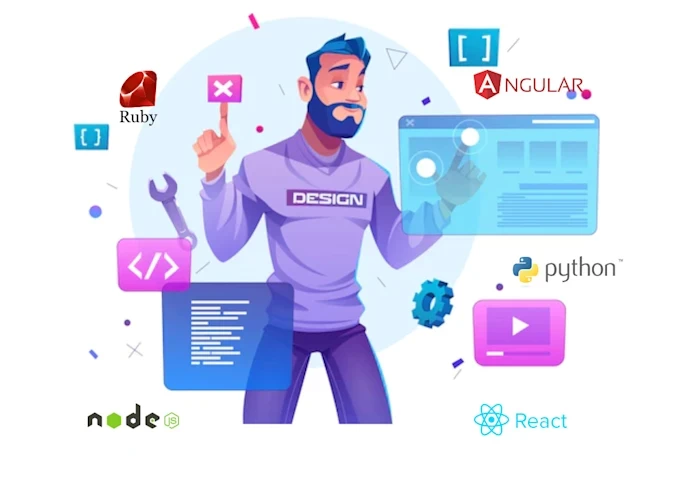
Python Full Stack Development equips learners with the skills to build dynamic web applications using Python for backend development and modern frontend technologies. It covers Python, Django/Flask, HTML, CSS, JavaScript, and databases, enabling end-to-end web development from UI design to server-side logic and deployment.

Java Full Stack Development involves building complete web applications using both front-end and back-end technologies. Developers work with core Java, Spring Boot, and Hibernate on the backend, and HTML, CSS, JavaScript, and frameworks like Angular or React on the frontend. It covers the entire development lifecycle from designing UI to managing databases and deploying applications.