- Call: +1 (972) 215-6624,
- Email: [email protected]


Instructor: MASS Group Trainer
Data Science with AI & ML is a comprehensive program designed to build expertise in data analysis, statistical modeling, machine learning, and artificial intelligence. This course prepares learners to work with real-world datasets, develop predictive models, and implement intelligent solutions using Python and industry-standard tools.
Starting from the fundamentals of Python and data manipulation, the course advances through core concepts like data visualization, supervised and unsupervised learning, natural language processing (NLP), deep learning, and real-time AI applications. Emphasis is placed on hands-on experience through mini-projects, case studies, and end-to-end capstone projects.
Python for Data Science
Data Wrangling with NumPy & Pandas
Data Visualization using Matplotlib & Seaborn
Statistics & Probability for Data Science
Supervised Learning: Linear & Logistic Regression, Decision Trees, Random Forest
Unsupervised Learning: K-Means, Hierarchical Clustering, PCA
Model Evaluation & Hyperparameter Tuning
Natural Language Processing (NLP)
Introduction to Deep Learning using TensorFlow/Keras
Real-Time Project Work & Deployment
Graduates & working professionals from IT, statistics, or engineering backgrounds
Aspiring Data Scientists, ML Engineers, and AI Developers
Business Analysts & Software Developers looking to transition to AI/ML
Entrepreneurs and professionals seeking data-driven decision-making skills
Gain hands-on experience with data analysis and visualization tools
Build, train, and evaluate machine learning models
Understand the end-to-end data science lifecycle
Apply AI & ML techniques to solve real-world problems
Prepare for roles like Data Scientist, ML Engineer, AI Developer, or Analyst
What is Full Stack AI?
Data Science Lifecycle
AI vs ML vs Deep Learning
Python Basics: Syntax, Variables, Data Types
Control Structures, Loops, Functions
Data Structures in Python: List, Tuple, Dict, Set
Introduction to NumPy
Pandas DataFrames: Loading & Manipulating Data
Data Cleaning: Handling Missing Values, Type Conversion
Exploratory Data Analysis (EDA)
Data Visualization using Matplotlib & Seaborn
Interactive Dashboards using Plotly
SQL Basics: SELECT, WHERE, JOINs
Aggregations, GROUP BY, Subqueries
SQL for Exploratory Data Analysis
Descriptive & Inferential Statistics
Probability Distributions, Central Tendency
ML Workflow: Supervised vs Unsupervised
Linear & Logistic Regression
Decision Trees, Random Forest, Gradient Boosting
Clustering: K-Means, Hierarchical
Dimensionality Reduction: PCA
Model Evaluation: Confusion Matrix, ROC, RMSE
Feature Scaling & Encoding
Handling Outliers, Skewness, Missing Data
Feature Selection Techniques
Hyperparameter Tuning with GridSearchCV
Cross-Validation Techniques
Basics of Neural Networks (ANNs)
CNNs for Image Classification
RNNs & LSTMs for Sequence Modeling
Tuning Deep Learning Models: Dropout, BatchNorm, Callbacks
Transfer Learning (ResNet, MobileNet)
NLP Basics: Text Cleaning, Tokenization
Vectorization Techniques: BOW, TF-IDF, Word2Vec
Sentiment Analysis with LSTM
Model Saving: Pickle, Joblib
Deploying with Flask/Streamlit
Docker, GitHub, Versioning
Cloud Deployment (Heroku, AWS Intro)
Monitoring & Updating Deployed Models
Real-World Case Studies (e.g., Fraud Detection, Recommendation Engines)
Capstone Project: Data Collection, EDA, Modeling
Capstone Project: Deployment & Demo
✅ GitHub Portfolio (3–4 Mini Projects)
✅ A Fully Deployed AI Model
✅ AI-Focused Resume
✅ Mock Interview Q&A Preparation
0 Reviews
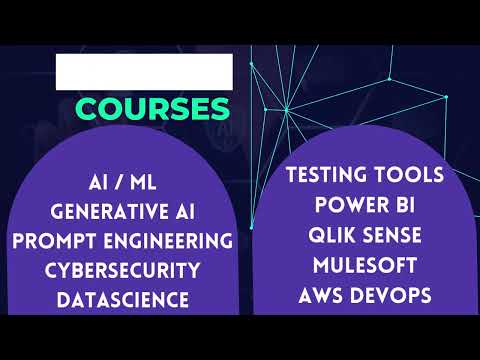

AWS DevOps combines the power of Amazon Web Services with DevOps practices to automate and streamline software development, deployment, and infrastructure management. It enables faster delivery, continuous integration & deployment (CI/CD), infrastructure as code (IaC), and scalable cloud solutions using tools like AWS CodePipeline, EC2, S3, CloudFormation, and more.

Prompt engineering is the practice of designing and refining instructions, or prompts, to get a desired output from a generative AI model. It's the process of giving an AI model clear, specific, and well-structured input to guide its response and improve its accuracy and relevance. Essentially, it's about crafting the best possible query to get the best possible answer from an AI.

Data Science with AI/ML is a comprehensive course designed to build expertise in data analysis, machine learning, and artificial intelligence. Learners will gain hands-on experience with Python, data visualization, predictive modeling, deep learning, and real-time AI applications. This course is ideal for aspiring data scientists, analysts, and AI professionals aiming to work on real-world projects and build a strong career in data-driven technologies.