- Call: +1 (972) 215-6624,
- Email: [email protected]


Instructor: MASS Group Trainer
Prompt engineering is the art and science of designing and refining inputs, or "prompts," to elicit a desired output from a generative artificial intelligence (AI) model, such as a large language model (LLM). It is a crucial skill for effectively interacting with and controlling AI systems.
Prompts: The instructions, questions, or data you provide to an AI model. They can be simple, like a single word, or complex, including a persona for the AI to adopt, specific constraints, and examples.
Generative AI: AI models that can generate new content, such as text, images, or code, based on the patterns they learned from their training data.
Iterative Process: Prompt engineering is not a one-time action. It's a continuous process of drafting a prompt, testing it, evaluating the output, and refining the prompt to achieve a better result.
By carefully crafting prompts, you provide the AI with the necessary context, instructions, and examples to help it understand your intent. This process helps to:
Improve Accuracy and Relevance: A well-engineered prompt guides the AI to produce a more precise, coherent, and relevant response.
Increase Control: It gives users more control over the AI's output, enabling them to specify the desired format, style, and tone.
Enhance Efficiency: By getting better results on the first try, it reduces the time and effort needed to edit or re-prompt the AI.
Several techniques are used in prompt engineering, including:
Zero-shot prompting: Giving the AI a task without any examples.
Few-shot prompting: Providing the AI with a few examples of input and desired output to guide its response.
Chain-of-thought prompting: Breaking down a complex task into intermediate steps, which helps the AI reason through the problem and produce a more accurate answer.
Modules: 1 (Intro), 2 (Crafting Prompts), 11 (Excel + AI)
Focus: ChatGPT basics, prompt design principles, avoiding pitfalls.
Practical: Design prompts for data tasks in Excel.
Modules: 3 (Contextual Awareness), 5 (Domain Strategies), 12 (AI Presentations)
Focus: Multiturn conversations, domain-specific prompts (NLP/Creative).
Practical: Create dynamic prompts for AI-generated presentations.
Modules: 6 (Bias/Ethics), 7 (Collaboration), 14 (LinkedIn Hacks)
Focus: Bias mitigation, team projects, personal branding.
Practical: Draft ethical guidelines; optimize LinkedIn profiles using AI.
Modules: 4 (Advanced Techniques), 8 (Optimization), 17 (Coding + AI)
Focus: Multimodal prompts, fine-tuning, scaling prompts, AI-assisted coding.
Practical: Optimize prompts for code generation tasks.
Modules: 13 (Report-Making), 18 (AI Art), 15 (Business Launching)
Focus: Research prompts, art generation, AI-driven business ideation.
Practical: Generate prompts for market research reports; design art prompts.
Modules: 9 (Future Trends), 16 (Personal Branding)
Focus: Adaptive prompting, emerging tech, AI for personal branding.
Practical: Develop a self-learning prompt system; plan AI-enhanced brand strategy.
Modules: 10 (Capstone Project)
Focus: Identify real-world problem, design solution.
Practical: Begin project work (e.g., build a prompt-based tool for a specific industry).
Modules: 10 (Capstone Project)
Focus: Refine solution, iterative testing, final presentation.
Practical: Present capstone project; peer feedback session.
Balance: Combines theoretical modules (1-10) with applied skills (11-18) for relevance.
Capstone Emphasis: Dedicates Weeks 7–8 for project work, ensuring depth.
Pacing: ~2 modules/week (early weeks) + focused capstone (late weeks).
Practical Integration:
Week 1: Excel prompts
Week 2: Presentation prompts
Week 5: Art/business prompts
Week 6: Future tech/branding
Ethics Early: Module 6 in Week 3 ensures responsible foundations before advanced topics.
0 Reviews
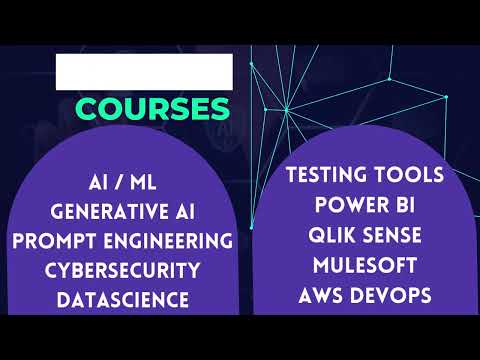

AWS DevOps combines the power of Amazon Web Services with DevOps practices to automate and streamline software development, deployment, and infrastructure management. It enables faster delivery, continuous integration & deployment (CI/CD), infrastructure as code (IaC), and scalable cloud solutions using tools like AWS CodePipeline, EC2, S3, CloudFormation, and more.

Data Science with AI/ML is a comprehensive course designed to build expertise in data analysis, machine learning, and artificial intelligence. Learners will gain hands-on experience with Python, data visualization, predictive modeling, deep learning, and real-time AI applications. This course is ideal for aspiring data scientists, analysts, and AI professionals aiming to work on real-world projects and build a strong career in data-driven technologies.
Digital Marketing with AI is a future-focused course that combines core digital marketing strategies with cutting-edge artificial intelligence tools. Learn how to optimize campaigns, automate customer journeys, generate content, analyze data, and boost ROI using AI-powered platforms like ChatGPT, Google AI, and automation tools. Perfect for marketers, entrepreneurs, and students looking to stay ahead in the digital world.